
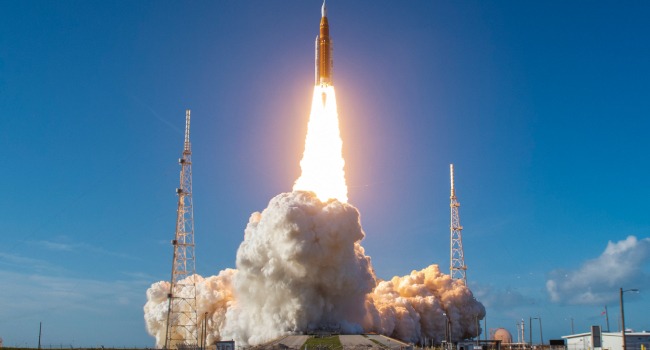
Astronauts Begin NASA Artemis II Lunar Mission
The NASA Artemis II lunar mission begins with a historic blast-off on April 1, 2026, sending four astronauts on the first crewed lunar flyby in over 50 years. The launch from Kennedy Space Center in Florida marked a major milestone for space exploration, showcasing the Space Launch System (SLS) rocket, the most powerful American spacecraft designed for deep-space missions. This mission is expected to set new records for human travel beyond Earth.
The crew includes NASA astronauts Reid Wiseman, Victor Glover, Christina Koch, and Canadian Space Agency (CSA) astronaut Jeremy Hansen. Clad in vibrant orange suits with blue trim, the astronauts lifted off amid a roaring cascade of flames, thrilling spectators and NASA teams alike. “We have a beautiful moonrise. We’re headed right at it,” said mission commander Reid Wiseman as the spacecraft ascended into orbit.
President Donald Trump hailed the launch as a remarkable achievement, praising “our brave astronauts” for their historic journey. The mission, he emphasized, signals America’s leadership in space exploration at a time of heightened global competition.
Following lift-off, the crew successfully conducted “proximity operations” demonstrations, testing how the Orion capsule can maneuver relative to other spacecraft—a critical skill for future Moon landings. Pilot Victor Glover remarked, “Great flying with you, Houston. Nice vehicle,” reflecting the crew’s smooth execution of these complex operations. NASA officials also noted minor post-launch issues, including a brief communication glitch and a controller problem in the spacecraft’s toilet system, both of which were quickly resolved.
The Artemis II lunar mission represents several firsts: it will carry the first person of color, the first woman, and the first non-American on a lunar flyby. The mission is planned to last roughly 10 days, with astronauts looping around the Moon to capture new imagery and conduct scientific observations. If all goes according to plan, the crew will travel farther from Earth than any humans have ever ventured, a feat that underscores the mission’s historic significance.
This mission also serves as a crucial step toward NASA’s long-term lunar goals, including establishing a permanent base by 2028. Artemis II is the inaugural crewed flight of the SLS rocket, developed to enable repeated Moon missions and provide a platform for deeper space exploration. The launch was initially scheduled for February but faced multiple delays and technical challenges, including repairs and investigations into prior anomalies.
Thousands of spectators, including space enthusiast Sian Proctor, gathered along Florida’s Space Coast to witness the moment. “I’m just so happy that we’re going back to the Moon,” Proctor said, emphasizing the mission’s significance for humanity. Local authorities reported that roughly 400,000 people were in attendance, reflecting widespread public excitement.
NASA Administrator Jared Isaacman highlighted the mission’s importance: “NASA is back in the business of sending people to the Moon.” He stressed that Artemis II not only demonstrates technological achievement but also reaffirms the United States’ commitment to leading human space exploration.
The Artemis II lunar mission also has broader geopolitical implications. The United States faces increased competition from China, which plans to land astronauts on the Moon by 2030. Isaacman noted that competition helps mobilize national resources and can drive innovation. Analysts have also pointed out the role of private-sector partnerships in accelerating lunar exploration, with companies contributing crucial technology to ensure mission success.
As the astronauts begin their journey, the mission underscores a renewed era of American space leadership, combining scientific discovery, human exploration, and international cooperation. The Artemis II lunar mission is a pivotal step toward long-term lunar habitation, future Mars missions, and a deeper understanding of humanity’s place in space.
From the thunderous blast-off to the anticipated Moon flyby, the NASA Artemis II lunar mission exemplifies both the spirit of exploration and the drive to extend human presence beyond Earth. With the eyes of the world watching, this mission sets the stage for a new chapter in space history.