
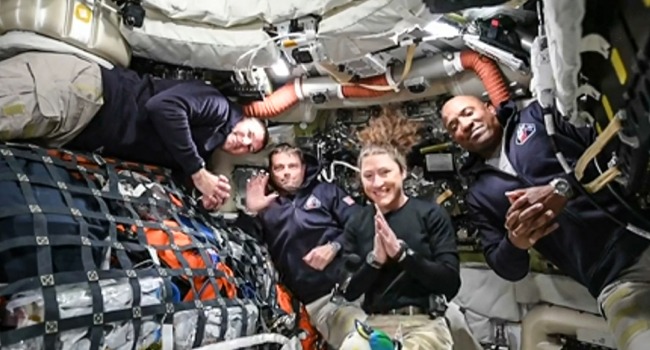
Artemis II Nears Pacific Splashdown Finale
Artemis II nears Pacific splashdown finale as the world watches the historic return of the Orion spacecraft. After a groundbreaking journey that took humanity further into space than ever before, the four-person crew is preparing for the most dangerous phase of their mission: reentry. This final descent will test the limits of NASA’s engineering and the resilience of the astronauts as they transition from the deep vacuum of space back to the waters of the Pacific Ocean.
The atmosphere at Mission Control is thick with anticipation as the Orion capsule, named Integrity, hurtles toward Earth at speeds not seen in over half a century. Launched on April 1, 2026, the Artemis II mission represents the first time humans have ventured toward the moon since the Apollo era. Now, after nearly ten days in space, Commander Reid Wiseman, Pilot Victor Glover, and Mission Specialists Christina Koch and Jeremy Hansen are on the verge of completing their odyssey. The final hurdle is a blistering reentry through Earth’s atmosphere at Mach 32, where the capsule’s heat shield must withstand temperatures of thousands of degrees.
Engineers are particularly focused on the performance of the life-protecting heat shield. During an uncrewed test flight in 2022, the shield exhibited unexpected pockmarking, and this mission serves as the ultimate validation of the fixes implemented since then. The reentry process involves a period of intense heat that creates a six-minute communication blackout, a stretch of time that flight directors describe as a period of “irrational fear.” During these minutes, the world will wait in silence to see if the parachutes deploy correctly to slow the spacecraft from its staggering 23,840 mph descent to a gentle 19 mph splashdown.
The mission has been a series of record-breaking triumphs. By reaching a distance of 252,756 miles from Earth, the Artemis II crew officially broke the record previously held by the Apollo 13 mission. While they did not land on the lunar surface, the crew captured high-definition imagery of the moon’s far side and documented a total solar eclipse from a perspective never before experienced by humans. These visual records, including a stunning “Earthset” photo reminiscent of the iconic “Earthrise” from 1968, have reignited global interest in lunar exploration. The mission even garnered attention from world leaders and Hollywood stars, underscoring its cultural and scientific significance.
However, the journey was not without its challenges. The crew faced several technical hurdles, including valve malfunctions in the propellant and drinking water systems. Perhaps most notoriously, a failure in the capsule’s waste management system forced the astronauts to utilize contingency bags and funnels for much of the trip. Despite these “inconveniences,” the crew remained focused and optimistic. Christina Koch remarked that exploration requires sacrifice and risk, emphasizing that the data gathered on these hardware failures is exactly why test flights are conducted before humanity attempts a permanent lunar base.
The recovery effort is a massive logistical operation led by NASA and the Department of Defense. The USS John P. Murtha is currently stationed in the Pacific, accompanied by a fleet of helicopters and specialized recovery teams ready to extract the astronauts from the water. This partnership between civilian and military sectors mirrors the recovery procedures used during the 1970s but utilizes 21st-century technology to ensure the safety of the returning pioneers.
As Artemis II nears Pacific splashdown finale, the success of this mission clears the path for the next stages of the Artemis program. Artemis III is slated to test docking procedures in lunar orbit next year, while Artemis IV aims to return humans to the lunar surface by 2028. The lessons learned during this flight—from the durability of the heat shield to the reliability of life support systems—will be integrated into future designs to ensure that when the next crew lands on the south pole of the moon, they do so with the highest possible margin of safety.
Commander Wiseman reflected on the mission’s spiritual impact, noting that seeing Earth from such a vast distance serves as a reminder of the planet’s beauty and fragility. As the capsule enters the final miles of its journey, the legacy of Artemis II is already secure. It has proven that the dream of deep-space exploration is alive and that humanity is ready to return to the moon, not just for a visit, but to stay. The successful splashdown on Friday will mark the end of a mission and the beginning of a new era in human history.
Source:
Based on NASA mission updates and official press releases from the Kennedy Space Center and Johnson Space Center as of April 10, 2026.